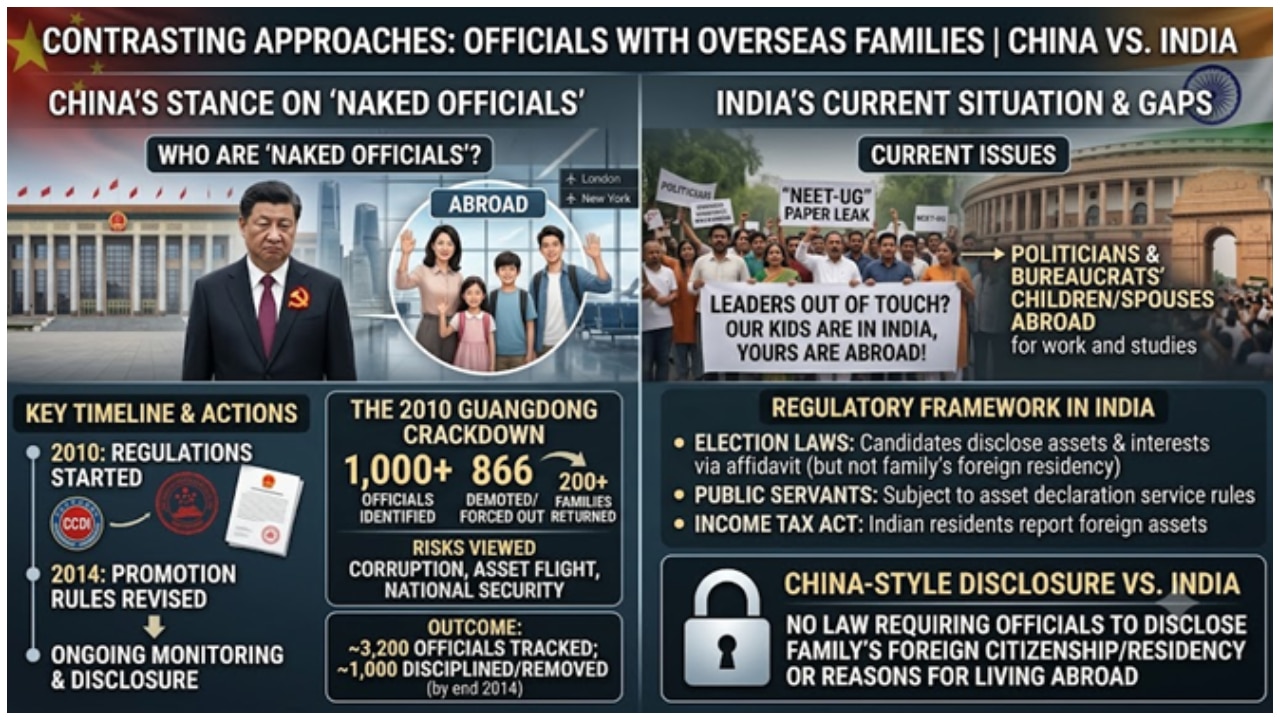
In India, many Indian politicians and bureaucrats send their children or spouses abroad for studies and work. Some of these individuals are living in developed countries as permanent residents or citizens. However, this issue was raised during the recently concluded National Eligibility cum Entrance Test (NEET-UG) paper leak protests, when protesters alleged that leaders and other high-ranking officers were out of touch with issues faced by the youth, as their own children are studying or working abroad. However, the situation is totally different in China, where the Communist Party of China (CPC) has for over the past 10 years, monitored, tracked, named and even taken stringent action against the practice of its officials sending their kids abroad to study or settle.
Who Are ‘Naked Officials’? Why Beijing Views Overseas Family Links As A Corruption, Security Risk?
In China, these officials are referred to as ‘Naked Officials’, as the neighbouring country views the issue through the lens of corruption and ‘Naked Officials’. If a high-ranking or normal government servant official’s family is abroad, the Chinese government sees it as a potential national security risk warranting scrutiny, disclosure and restrictions.
How China Tackles ‘Naked Officials’—and What Lessons India Can Learn
In China, the term ‘Naked Official’ is used for the officials of the CPC or the Chinese state whose families or kids have settled abroad as permanent residents or citizens, while the official remains in the country.
The term is generally used when the government official stays in the country while his/her family relocates abroad, leaving the official ‘naked’. China viewed this as a major issue, and for over a decade, it has been regulating and monitoring this category of public officials.
In 2009, the Central Commission for Discipline Inspection (CCDI) called for increased oversight of ‘Naked Officials’.
In 2010, China introduced strict regulations to monitor government officials whose family or kids had moved abroad. The prime focus of this practice was enhanced supervision to prevent corruption and illicit asset transfers in the country.
After the introduction of the regulation, the neighbouring country tightened its policies and revised its promotion rules in 2014.
The 2010 Guangdong Crackdown
The first major crackdown against these ‘naked officials’ took place in Guangdong Province, where officials identified over 1,000 officials. Out of these 1,000 officials, 866 were reportedly demoted or forced to resign or retire early. Some of these were mayors and other senior local officials. Nearly 200 officials arranged for their families to return to China.
By the end of 2014, the CODCP identified 3,200 ‘Naked Officials’ across the country. Out of these, 1,000 were either disciplined, reassigned or removed from their respective posts.
What About India? How Are Ministers, Officials With Relatives Abroad Treated?
In India, there is no law requiring ministers, MPs, members of state legislative assemblies, or civil servants to disclose whether their families or children are citizens or permanent residents of another country. There is also no law that binds them to disclose whether their immediate family lives abroad for studies or work.
However, asset declarations is required under election laws, service rules or tax laws.
It should be noted that electoral candidates are required to reveal their assets and financial interests to the Election Commission of India through an affidavit. Public servants, on the other hand, are bound by civil service rules to disclose their assets.
Indian residents are bound to report foreign assets, if any, under the Income Tax Act. However, India doesn’t have a China-style disclosure system focusing on tracking senior officials whose families live or work abroad.
Why India Urgently Needs A Public Debate On ‘Naked Officials’
It is to be noted that China does not automatically treat ‘naked officials’ as guilty but also requires extra supervision to prevent corruption and asset flight. Many Indian leaders have family living overseas, which would trigger extra oversight under a China-style rule.
from World – Latest News, Breaking News, LIVE News, Top News Headlines, Viral Video, Cricket LIVE, Sports, Entertainment, Business, Health, Lifestyle and Utility News | India.Com https://ift.tt/EMsSuma