Jerusalem: The conflict between Israel and Gaza has continued to be an issue of major international concern, with many developments on the ground that have drawn international attention to the situation. For months, there has been fighting, humanitarian strife in Gaza, and calls for a ceasefire and better protection of civilians. At the same time, diplomatic efforts have been focused on securing humanitarian aid, addressing the plight of displaced people, and finding a path towards a lasting resolution to the conflict.
The conflict in Gaza has led to massive destruction and a substantial casualty count. A significant portion of the population has suffered in terms of displacement, availability of essential supplies, and the worsening humanitarian situation. The extent of destruction and loss of civilian life has concerned international organizations and revived appeals for humanitarian assistance and protection of the civilian population.
What has Netanyahu said about Palestinian statehood?
On July 31, US President Donald Trump unveiled a phased roadmap that calls for the complete disarmament of Hamas and other armed groups, the transfer of governance to a new Palestinian transitional authority and the gradual withdrawal of Israeli forces under an internationally monitored process. Israel has rejected US President Donald Trump’s 15-point Gaza peace plan and will not withdraw its forces from the enclave until Hamas is “genuinely” disarmed, Prime Minister Benjamin Netanyahu announced on Sunday.
Israel has rejected the 15-point Gaza peace plan proposed by US President Donald Trump and will not pull out its forces from the territory until Hamas is “genuinely” disarmed, Prime Minister Benjamin Netanyahu announced on Sunday. Israel rejects the 15-point document,” Netanyahu said, referring to a proposal endorsed in late July by Hamas, according to Israeli media.
Speaking during a cabinet meeting, Netanyahu underlined that the Israeli army “will not carry out any withdrawal until Hamas is genuinely disarmed, and will continue to thwart threats against our forces and our citizens. “We are instructing IDF (Israel Defense Forces) soldiers to do whatever is necessary to protect themselves, our territory and our citizens,” Netanyahu said in a video released on social media.
Prime Minister Benjamin Netanyahu at the Start of the Government Meeting:
“Israel does not accept the 15-point document. The IDF will not carry out any withdrawal until Hamas is genuinely disarmed, and it will continue to thwart threats against our forces and citizens.”Full… pic.twitter.com/UrVY2FK9wO
— Prime Minister of Israel (@IsraeliPM) August 9, 2026
Israeli Prime Minister Netanyahu said that he is in communication with Washington about Israel’s peace plan, pressured by far-right coalition partners to hold a new vote on the issue and faced with numerous opinion polls that indicate he is in a close race with his competitors. “There are proposals that Washington has made, some of them could be accepted in Israel while there are others we will reject,” he said.
כל עוד אני ראש ממשלה, לא תקום מדינה פלסטינית – לא בעזה ולא ביו”ש. לא פת״חסטאן ולא חמאסטאן. pic.twitter.com/C1W8BIjckQ
— Benjamin Netanyahu – בנימין נתניהו (@netanyahu) August 10, 2026
Under pressure from far-right coalition partners calling for a new cabinet vote on the peace plan, Netanyahu, who is fighting a tough electoral battle according to opinion polls, said that Israel is in negotiations with Washington on this issue. He said, “They have ideas; some of them are acceptable to us, and some are not, and we know how to stand our ground on these matters.”
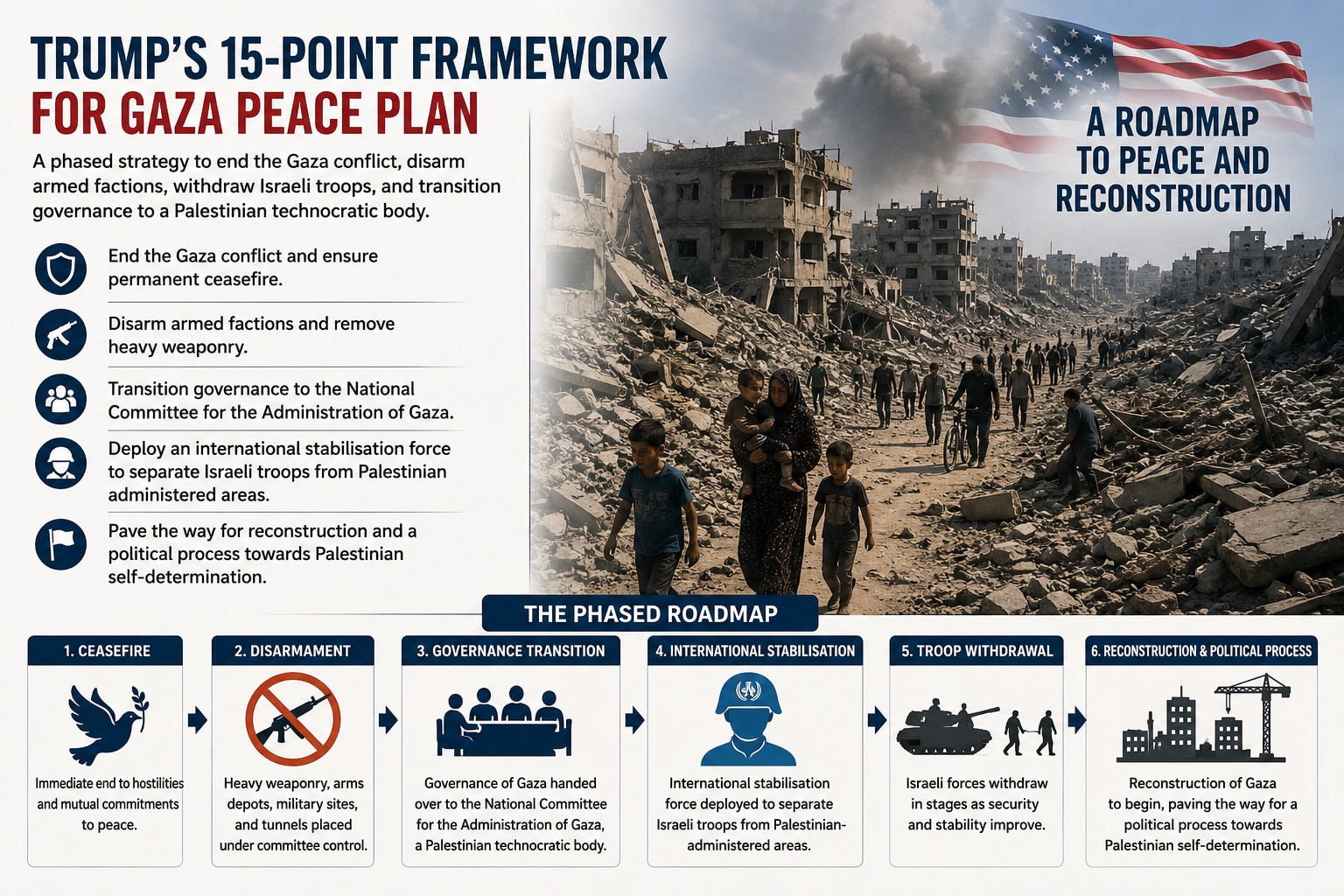
(Created using ChatGPT)
What does the Gaza peace plan propose for Palestinian governance?
A phased plan for ending the conflict in Gaza, disarming all armed groups, withdrawing Israeli troops from the territory, and transitioning governance of the strip to a Palestinian technocratic body, the National Committee for the Administration of Gaza, has been proposed by Trump in the form of a fifteen-point proposal. Under the roadmap, heavy weaponry, arms depots, military sites, and tunnels would be placed under the committee’s control, while an international stabilisation force would be deployed to separate Israeli troops from Palestinian-administered areas. Israeli forces would then withdraw in stages, allowing for reconstruction and the political process of building Palestinian self-governance.
Key reasons behind Netanyahu’s opposition to Gaza peace plan
Perhaps, one major obstacle remains: while Trump previously stated that both sides accepted the framework and that Hamas agreed to lay down its arms, Israel insists full demilitarisation of Hamas must precede any troop pullout, even as it continues military strikes despite the ceasefire established last October. While the ceasefire was established last year, Israel continues its military operations. Another important aspect contributing to the widening rift over the peace plan has drawn a rare, unified reaction from eight Muslim-majority countries. According to the news agency ANI report, the United Arab Emirates joined Qatar, Jordan, Indonesia, Pakistan, Turkiye, Saudi Arabia, and Egypt in issuing a joint declaration condemning ongoing Israeli military operations in Gaza. The foreign ministers warned that continued military action risks undermining international peace efforts, cautioning that it could “derail the political process”, provoke further regional escalation, and deepen the humanitarian crisis in Gaza.
In short, the Key Reasons Behind Netanyahu’s Opposition to the Gaza Peace Plan are Opposition to Palestinian statehood, Security concerns over Gaza, Demand for Hamas disarmament, Concerns over Gaza’s future governance
Rejection of a two-state solution, Pressure from right-wing coalition partners.
(With Inputs from agencies)
from World – Latest News, Breaking News, LIVE News, Top News Headlines, Viral Video, Cricket LIVE, Sports, Entertainment, Business, Health, Lifestyle and Utility News | India.Com https://ift.tt/jnUmhVl